I think the the most difficult job in teaching goes to the math teachers. Theirs is the most despised subject. It's the most abstract, difficult to comprehend, and boring. It is harder for math teachers to fit the curriculum into all of the learning styles (but can still be done with great results). But I think one of the most difficult challenges facing math teachers is having a classroom full of 25(ish) students that are all at very different levels and abilities. I think that that math, more than any other subject, needs to be individualized as much as possible for each student. In my math experience when I didn't understand a concept I didn't do the home work, did poorly on the test and moved on to another subject I was bound NOT to get because it inevitably builds on the stuff I didn't understand.
Ok, so here's a solution: Khan Academy
Khan Academy is a free online "school" where, the ultimate goal, anyone can learn anything. (Wikipedia has a good history on it here.) They began with math so as of right now it's the most comprehensive subject. You can learn from basic addition all the way to calculus. It also includes a pretty good chunk of science, some economics, and bits and pieces of other subjects. The first thing to do when visiting is click on the "practice" link. It should have you log in with a google account or Facebook. The login tracks your progress through the practice problems. The next thing you should see is a math tree and all of it's interconnectedness. When you click on a module it takes you to some practice problems. If you don't understand the topic there is a link to one or more videos at the top that will show lessons and example problems. Then you can go back and practice what you've learned. It keeps track of how proficient you are and awards you with achievements like many modern video games do.
I know it's still a lecture and practice format, much like what most math students already get, but here's some ideas of how this can be used:
Imagine that a room of laptop wielding math students come into class and begin by logging on to Khan Academy. They may all be on different lessons depending on their ability. The teacher then walks around the room and meets with each student individually helping them and clarifying concepts or pulling them aside for a one-on-one mini lesson while the rest of the class continues working. The beauty of this is that a whole gamut of ability levels can be taught by the same teacher in one classroom. The students who struggle can spend more time on mastering concepts before moving on. The exceptional students can move ahead and learn at their own pace and master more difficult concepts without waiting in boredom. Less frustration all around, and for me taking away the frustration made me ENJOY learning math.
Oh, and M.I.T. has a similar free open course program. Definitely worth checking out.
Friday, June 24, 2011


Wednesday, June 22, 2011
Adaptive Testing
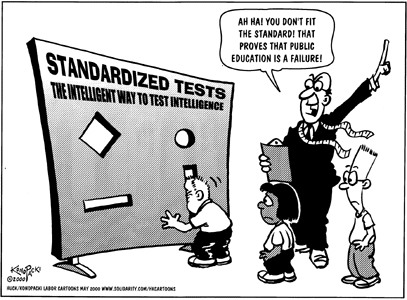
I have many beefs with standardized testing. In Utah we use a Criterion Reference Test (CRT) that must be taken by students in 3rd through 8th grade. In my opinion, one of the big flaws with this kind of test is that by having the same test for all students compares them against each other. The tests are graded on a curve with the bulk of the students falling into the "C"range. This makes it so your score on the test only shows how well you did compared to the other students. I'm sure there are many other reasons CRT-type tests are a poor measurement of learning, but this is one that comes to mind.
Luckily, thanks to computer assisted testing some fo the issues with standardized testing can be fixed. Adaptive testing seems to be a step in the right direction. Each student's test will change and adapt according to how well they are doing. If a students gets an answer correct then they move on to a harder question. If they get it incorrect then the next question is easier. Each student then gets a personal test based on what they know. To show true progress though, there would have to be a pre- and post-test. Here's a link to an article about Utah's possible change:
Utah Considers Adaptive Tests
Wednesday, June 15, 2011
5 Google Docs Tips
CNET has posted a great video on 5 Google Docs tips you should definitely know about. These are simple and take care of some issues that have made me slow converting to Docs.
5 Fantastic Google Docs Tips
5 Fantastic Google Docs Tips
Subscribe to:
Posts (Atom)