Quick repost of a good article. If you haven't accepted the paradigm shift, it's time.
http://mindshift.kqed.org/2011/07/the-seven-golden-rules-of-using-technology-in-schools/
Tuesday, August 2, 2011


Friday, June 24, 2011
Individualizing Math Curriculum
I think the the most difficult job in teaching goes to the math teachers. Theirs is the most despised subject. It's the most abstract, difficult to comprehend, and boring. It is harder for math teachers to fit the curriculum into all of the learning styles (but can still be done with great results). But I think one of the most difficult challenges facing math teachers is having a classroom full of 25(ish) students that are all at very different levels and abilities. I think that that math, more than any other subject, needs to be individualized as much as possible for each student. In my math experience when I didn't understand a concept I didn't do the home work, did poorly on the test and moved on to another subject I was bound NOT to get because it inevitably builds on the stuff I didn't understand.
Ok, so here's a solution: Khan Academy
Khan Academy is a free online "school" where, the ultimate goal, anyone can learn anything. (Wikipedia has a good history on it here.) They began with math so as of right now it's the most comprehensive subject. You can learn from basic addition all the way to calculus. It also includes a pretty good chunk of science, some economics, and bits and pieces of other subjects. The first thing to do when visiting is click on the "practice" link. It should have you log in with a google account or Facebook. The login tracks your progress through the practice problems. The next thing you should see is a math tree and all of it's interconnectedness. When you click on a module it takes you to some practice problems. If you don't understand the topic there is a link to one or more videos at the top that will show lessons and example problems. Then you can go back and practice what you've learned. It keeps track of how proficient you are and awards you with achievements like many modern video games do.
I know it's still a lecture and practice format, much like what most math students already get, but here's some ideas of how this can be used:
Imagine that a room of laptop wielding math students come into class and begin by logging on to Khan Academy. They may all be on different lessons depending on their ability. The teacher then walks around the room and meets with each student individually helping them and clarifying concepts or pulling them aside for a one-on-one mini lesson while the rest of the class continues working. The beauty of this is that a whole gamut of ability levels can be taught by the same teacher in one classroom. The students who struggle can spend more time on mastering concepts before moving on. The exceptional students can move ahead and learn at their own pace and master more difficult concepts without waiting in boredom. Less frustration all around, and for me taking away the frustration made me ENJOY learning math.
Oh, and M.I.T. has a similar free open course program. Definitely worth checking out.
Ok, so here's a solution: Khan Academy
Khan Academy is a free online "school" where, the ultimate goal, anyone can learn anything. (Wikipedia has a good history on it here.) They began with math so as of right now it's the most comprehensive subject. You can learn from basic addition all the way to calculus. It also includes a pretty good chunk of science, some economics, and bits and pieces of other subjects. The first thing to do when visiting is click on the "practice" link. It should have you log in with a google account or Facebook. The login tracks your progress through the practice problems. The next thing you should see is a math tree and all of it's interconnectedness. When you click on a module it takes you to some practice problems. If you don't understand the topic there is a link to one or more videos at the top that will show lessons and example problems. Then you can go back and practice what you've learned. It keeps track of how proficient you are and awards you with achievements like many modern video games do.
I know it's still a lecture and practice format, much like what most math students already get, but here's some ideas of how this can be used:
Imagine that a room of laptop wielding math students come into class and begin by logging on to Khan Academy. They may all be on different lessons depending on their ability. The teacher then walks around the room and meets with each student individually helping them and clarifying concepts or pulling them aside for a one-on-one mini lesson while the rest of the class continues working. The beauty of this is that a whole gamut of ability levels can be taught by the same teacher in one classroom. The students who struggle can spend more time on mastering concepts before moving on. The exceptional students can move ahead and learn at their own pace and master more difficult concepts without waiting in boredom. Less frustration all around, and for me taking away the frustration made me ENJOY learning math.
Oh, and M.I.T. has a similar free open course program. Definitely worth checking out.
Wednesday, June 22, 2011
Adaptive Testing
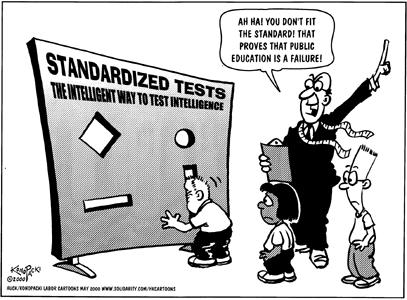
I have many beefs with standardized testing. In Utah we use a Criterion Reference Test (CRT) that must be taken by students in 3rd through 8th grade. In my opinion, one of the big flaws with this kind of test is that by having the same test for all students compares them against each other. The tests are graded on a curve with the bulk of the students falling into the "C"range. This makes it so your score on the test only shows how well you did compared to the other students. I'm sure there are many other reasons CRT-type tests are a poor measurement of learning, but this is one that comes to mind.
Luckily, thanks to computer assisted testing some fo the issues with standardized testing can be fixed. Adaptive testing seems to be a step in the right direction. Each student's test will change and adapt according to how well they are doing. If a students gets an answer correct then they move on to a harder question. If they get it incorrect then the next question is easier. Each student then gets a personal test based on what they know. To show true progress though, there would have to be a pre- and post-test. Here's a link to an article about Utah's possible change:
Utah Considers Adaptive Tests
Wednesday, June 15, 2011
5 Google Docs Tips
CNET has posted a great video on 5 Google Docs tips you should definitely know about. These are simple and take care of some issues that have made me slow converting to Docs.
5 Fantastic Google Docs Tips
5 Fantastic Google Docs Tips
Monday, May 30, 2011
The "Cloud" and Browser Wars
To a lot people the "cloud" is a mysterious term used by technophiles and T.V. commercials. The commercial that irks me the most is the Microsoft commercial where some tech idiot encounters a problem and a tech-savy person comes along and says "To the cloud". Suddenly the problem is solved and everyone is happy. The worst of these commercials shows a family taking a family portrait and the mom goes "to the cloud" and removes her kids' weird faces for smiling ones. Great job Microsoft, now not only do you have people still wondering "what in the heck is the 'cloud'" but now they think it's some sort of picture editing software. For a good explanation check out Google's 20 Things I Learned about the Internet. It's a great little e-book that will get you all smart-feeling in no time. It takes about 15-20 minutes to read but it's well worth it. Of course, being produced by Google, it's biased towards its own products and rightfully so.
That brings us on to internet browsers. To view content on the internet you have about 4 predominate choices. There is of course Microsoft Internet Explorer with which most of us have been forced to use most of our lives. The other big personal computer company, Apple, offers their own browser named Safari. Both of these browsers are copyrighted and owned by their respective companies. They decide what these browsers can and cannot do. The other two browsers in the running are Mozilla Firefox and Google's Chrome. These two products are open source and anyone with programming smarts can modify the product, the idea being that collaboration between many minds will create a better product. And in many ways, it has.
Now, my intention isn't to compare all of the pros and cons of these products, that can be found all over the internet made by people much more knowledgeable than me (for example, here). But I would rather look at what can be best used by students and teachers to streamline class and make learning easier.
First off you must know I have a built in bias, I'm an Apple fanboy. Being such, I have used Safari for years and have no major complaints, it's a good browser and does what I need it to do. But other than looking better and not crashing, it doesn't have much up on the other browsers.
My other bias: I regularly curse Microsoft (both in the profane and the dark arts). After trying other browsers and using all four of these regularly, I HATE Internet Explorer. It seems like a malicious lackey of our school district's IT department, trying to stop me from introducing new tech into my classroom and hindering my overall productivity. I'm always fighting with this devilish little piece of software trying to get it to do mundane tasks. I could go on, but in the end it just lacks some of the features the other browsers have that I feel should be standard and crashes way to often (IE 10 is supposed to be the bee's knees, but sorry Microsoft, it's too late).
So last year to combat my frustration, I installed Firefox. I had many of the problems solved and really liked some of Firefox's customizable features. It has a great gallery of extensions which allow you to expand the capabilities of the browser. For example, if you want to highlight any old web page and come back later to to see what you've highlighted, you can do it. You can block out swear words instead of whole sites. Being an open source program anyone can pretty much program an extension to do anything they want it to do. I have a friend who made an extension to sort his Netflix queue by how many stars a movie has instead of the default sorting options Netflix has. This is the beauty of open source platforms, they get better all of the time without waiting for the slow cogs at a big software company to turn. I'm sure there are many extensions that could be used in a school setting, but I never had time to explore them.
Lastly we have Google's offering, Chrome. I think that this browser, MUCH more than any of the others can be used in education. If you've read the e-book linked at the beginning of the article you'll be aware of some of its advantages. At the surface Chrome has a much simpler interface than the other browsers. When I introduce new tech to teachers I usually make the mistake of telling them, "it's easy." Most of them reply, "Oh, I've heard that before." For years they've been hearing about how technology is going to simplify their lives and yet every time they attempt to use is the learning curve is so steep they never become proficient users. Everything is trivial once you know it, but if a teacher never learns a new technology they will just feel frustrated, give up and go back to doing what they have always done. But with Chrome it really is easier. Chrome makes great use of HTML5. You don't need to know what this is but just know that IE9 doesn't have it. Here's an example of how this makes the internet easier:
One of the most simple tasks on a computer is attaching a file to an email. This is still a daunting task for many users (sorry Dad). We've all felt the frustration of saving a file and then browsing for it in and endless stream of subfolders. With Chrome (and gmail) you can simply drag the file and drop it on your email to attach it. No more searching. Simple.
The one thing that sets Chrome apart from the rest is its web store. Just like Firefox, the web store has extensions that expand the abilities of the browser. But that not the best part. The web store also allows to install apps in the Chrome browser. FOR FREE! Because many of these apps use a "cloud" nothing is stored on your computer. You can install as many apps as you like and all of your setting are far away in Google's magical server fairy land. You can then sync your Google account to Chrome so no matter what computer you log into, Chrome will save and load all of your settings and apps.
So go check out the app store. There is an education category and a collection of free student apps that you might find useful. I have recently been playing around with a number of these trying to thinks of ways to effectively use them with my curriculum.
Here are a few I might find useful (some of the apps are just links that take you to an outside website, others run in the browser):
Diigo
Art Project
Brightstorm
Cobocards
Evernote
Khan Academy
If you're not already addicted get the Angry Birds app for free!
Lost in the Woods
As a fairly new teacher, and one who is tackling the feat of starting a school where every student has a netbook, I feel that I get a lot of vague undirected encouragement to use technology. I read in books, blogs, news articles, and hear from other educators that this generation learns differently and we must change our teaching style to match that. A number of the books have great research convincing teachers that students brains work differently and we're boring them to death. The answer: Use technology to reach them. OK, that's fine and all, I'm convinced, but now what? I've never been taught any method but the traditional ones we're being discouraged to use. Even my online masters courses are a traditional read the book, listen to a lecture and take a quiz method with very little new innovative teaching methods. I feel like I'm stumbling around in the woods while clear voices call through the trees telling me that there is a way out and I need to find it. But when I ask which way no one responds.
My frustration with using technology in the classroom is complex and there is a healthy list of things to get peeved about. But the opportunities excite me enough that I really want to do it and succeed. To succeed teachers need more than just to be told to be different. We need to see what it looks like and see real life examples of new innovative teaching ideas. We need to lead each other out of the woods.
That's where this blog comes in. I am starting at a brand new school next year that will hand each one of the students a netbook that is to be used in every classroom. Each subject down to physical education must find applicable progressive ways to show the taxpayers that their money was spent to help increase learning not just to have a school with "cool stuff".
I have been testing and researching as much as I can and I hope that some of the ideas can be useful to others as well. I also hope to steal any of your ideas and share them with others. So I'll tell you my victories and failures and hope they help in some way to improve what you're doing in your classroom.
Subscribe to:
Posts (Atom)